

In times of growth, scaling a marketing team is often the last thing on a company’s mind—but that, my friends, is a huge mistake. The lean marketing team that got a business off the ground is not the one that will help it scale. Trust me; as a serial marketing team of one, I’ve experienced the fallout firsthand.![→ Download Now: The Illustrated Guide to Org Charts [Free Guide + Templates]](https://no-cache.hubspot.com/cta/default/53/7cbd0328-6c8c-40e0-98dd-c3b6e6be96f0.png)
Failing to scale your marketing team as you grow leads to overwhelm, poor quality, and missed goals, but how exactly do you structure your team for growth?
The tips shared in this article will help you scale from five to 25 people without losing speed, clarity, or impact. Each phase is triggered by revenue milestones and comes with hiring priorities, role evolution, and structure recommendations.
Table of Contents
- Why Marketing Team Structure Matters in Growth
- How to Structure Your Marketing Team As You Grow
- How to Scale a Marketing Team
- How to Prioritize Roles When Scaling a Marketing Team
- Best Tools for Scaling Marketing Teams
- FAQs About Scaling a Marketing Team
- Build to Scale, Not Just to Survive
Why Marketing Team Structure Matters in Growth
As companies grow, a scalable marketing team is crucial to preserving momentum.
A recent McKinsey survey found that nearly 67% of organizations report being overly complex and inefficient. In other words, poor roles and structure have led to slower decisions, redundancy, and reduced velocity.
But why is that? In my experience, it usually comes back to workload and productivity. More ambitious goals often mean bigger and a higher volume of tasks to tackle. Your marketing team size and roles should reflect your company’s revenue and growth goals, as well as what they demand.
For example, if you want to increase your content output, you need more content creators and strategists. If you’re launching a product, you’ll need a product marketing manager to do it right.
Piling more work on team members with already full plates will only lead to burnout and even employee churn. (Again, I’ve seen this firsthand.)
Co-founder of Stage 2 Capital and former HubSpotter Mark Roberge echoes this, saying:
“We have a long conversation with our founders out of the gate about their five-year scale plan and do a bottom-up analysis to understand the realistic inputs…That‘s a critical strategic decision that determines everything — how many reps you’ll hire, how many support people, how many engineers, how much property.”
Talent is a resource, and if you don’t get the resources needed to get a job done, don’t be surprised if it doesn’t happen. But that doesn’t mean you can just add to headcount mindlessly.
Common Mistakes When Growing a Marketing Team
When marketing teams scale without intentional structure, several patterns emerge that undermine performance. Some of the most common are:
Unclear role boundaries: According to Gallup, only 46% of employees feel clear about what’s expected of them (down from 56% in 2020). When ownership and responsibilities aren’t defined, critical tasks can fall through the gaps or team members can duplicate efforts. This leads to missed deadlines and confusion about who handles what.
I experienced this many years ago when my company was trying to keep teams as flat. A colleague and I were experts on the same topic and sat in the same seat, with the same responsibilities. In the sea of sameness, when it came to making decisions, and we disagreed, we found ourselves in a stalemate.
To resolve the issue, I outlined suggested lines of ownership and accountability so we always knew who ultimately had the final say.
This also helped protect us from another common issue when growing a marketing team…
Leadership bottlenecks: When all decisions flow through one person — which is inevitable without unclear roles — efficiency slows dramatically. Teams end up waiting for approval on routine tasks while opportunities pass by and dependent projects get delayed.
Disconnected channels: When you scale, communication between related departments can suffer. For instance, if content, demand generation, and product marketing operate in silos with no cross-team coordination, messaging can become inconsistent and muddled, taking its toll on final campaign quality.
Meeting fatigue: In an effort to improve communication, most companies turn to meetings, but I think we all know this comes with its own drawbacks. Flowtrace found that employees, on average, spend 392 hours per year in meetings — that’s over 16 full workdays annually. When talent is in unnecessary team meetings, they have less time to execute and can contribute to bottlenecks.
Underutilized talent: Hiring specialists before validating core channels wastes budget and creates roles without clear deliverables. Teams end up with expensive talent sitting idle.
All of these problems can compound. A well-thought-out hiring plan, like the one we’ll go into next, can help alleviate or even avoid them entirely.
How to Structure Your Marketing Team As You Grow
Elad Gil, an entrepreneur, operating executive, and investor/advisor to Stripe, says organizations can sustain 3x growth as team complexity increases by implementing the right organizational design.
That said, a marketing organization that’s scaling up will need a new team structure. The template below walks through three phases on the journey to a team of 25:
- Foundation (5-10 people)
- Specialization (11-17 people)
- Scale (18-25)
Common scaling mistakes include unclear hiring priorities, a lack of process, and poor alignment. We’ll discuss the marketing roles you need at each phase, the associated metrics, when to hire specialists, and what to look for in the right talent.
The best hiring sequence will ultimately vary from company to company, but these suggestions are a great place to start.
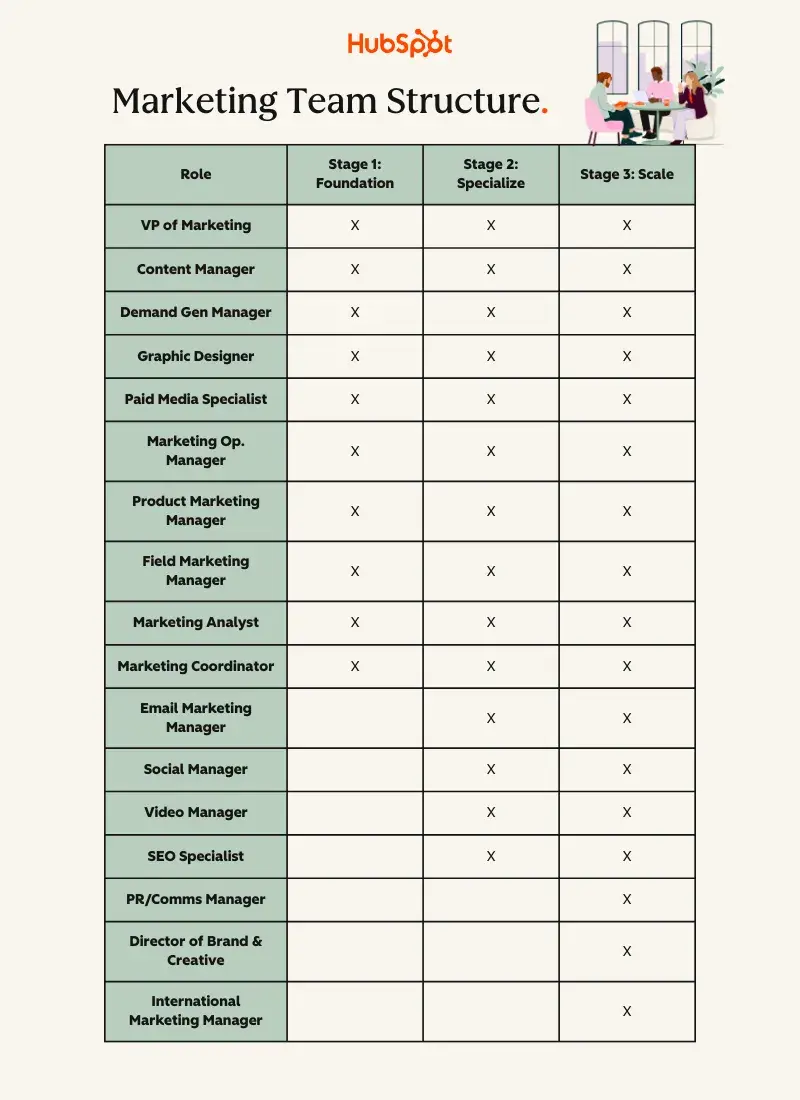
Phase 1: Foundation (5–10 People) – Foundational marketing roles should be hired early in team scaling.
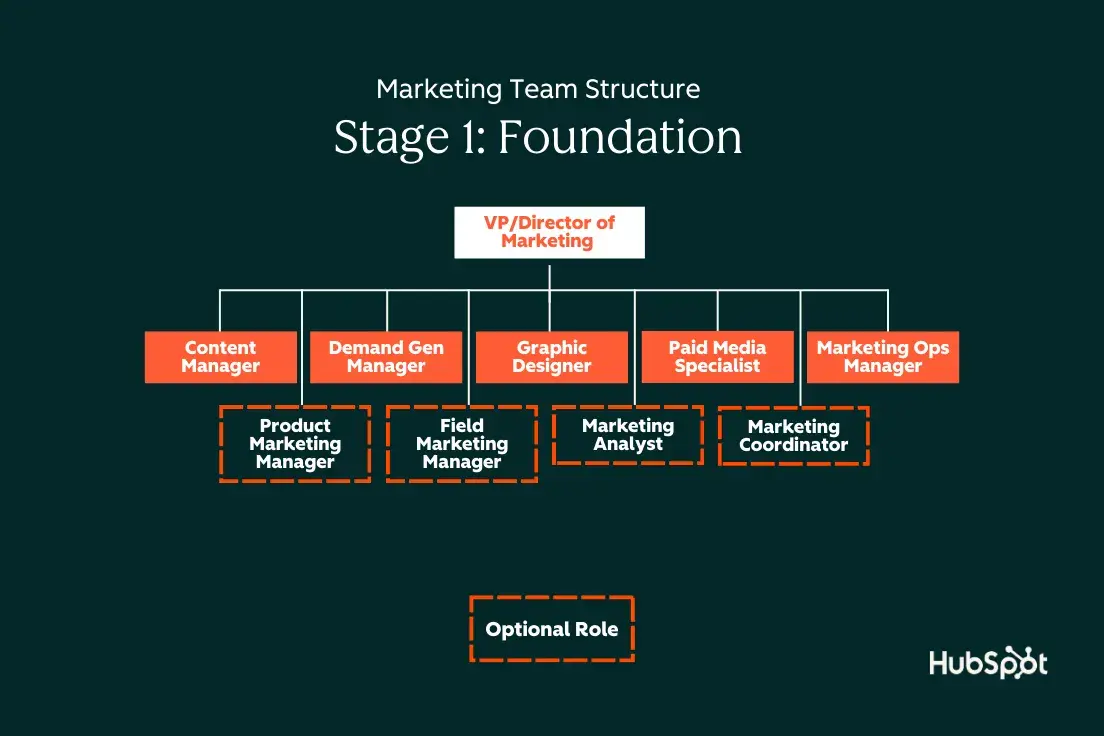
As a company reaches $5–15M in ARR and acquires over 100 customers, the first phase of team building begins.
That’s why this stage is all about establishing the core marketing functions and setting up essential tools and processes. A big part of this is hiring generalists with wide skill sets who can wear different hats if needed.
Learn more about the skills all marketers should have in our articles, “20 Technical Skills Every Marketer Needs and “How to Build the Strongest Small Marketing Team.”
Foundational Marketing Roles
While the priority of some roles will depend on the nature of your product and business, others are universal. The actual job titles may change, but here are the roles I’d recommend at this phase:
VP or Director of Marketing
This role leads strategy, manages early hires, and aligns the team with business goals. They also tend to be the marketing decision-maker and the one held accountable for hitting metrics.
Efficiency Metrics: Return on marketing investment (ROMI), Customer Acquisition Cost (CAC), Marketing-sourced pipeline, Marketing Efficiency Ratio (MER)
Content Marketing Manager
They own content creation and SEO. They may create a variety of content themselves (i.e., blog articles, emails, landing pages, videos) or manage the production by others.
Efficiency Metrics: Publishing frequency, organic traffic growth, content-attributed MQLs, first-30-day page traffic
Resources:
Demand Generation Manager
This role oversees acquisition and pipeline generation. They’re focused on getting conversions and leads to sales.
Efficiency Metrics: MQLs, SQLs, cost per acquisition (CPA), marketing-sourced pipeline, payback period
Graphic Designer
They create visual content, including website materials, social media, and premium content, among other things.
Efficiency Metrics: Campaign consistency rate, turnaround time per asset, engagement uplift (CTR, social shares), brand adherence audits
Paid Media Specialist
They manage advertising, paid social.
Efficiency Metrics: Impressions, CTR, CPC, CPA, ROAS (return on ad spend)
Resources:
- “10 Essential PPC Courses for Every Marketer”
- How to Build Pay-per-Click Marketing Campaigns [+ Best PPC Platforms, Tools, and Software]
(Optional) Marketing Operations Manager
They manage automation and reporting systems. This would include working with tools like HubSpot.
Efficiency Metrics: Marketing Efficiency Ratio (MER), campaign setup time, funnel conversion rates, data accuracy score
(Optional) Product Marketing Manager
They focus on messaging and positioning.
Efficiency Metrics: Sales enablement usage, win rate uplift, sales cycle reduction, product-qualified leads
Resources:
- How to Do Product Marketing Like A Pro: Strategy, Tips, & Examples
- Free Download: Ultimate Product Marketing Kit
- What Is a Product Marketing Manager? Job Description and Salary
(Optional) Event or Field Marketing Manager
They support in-person events, which may be especially helpful for B2B organizations.
Efficiency Metrics: Leads generated per event, CPL, event attendance rate, pipeline sourced from events
Resources:
(Optional) Marketing Analyst
They monitor, measure, and report on performance.
Efficiency Metrics: Dashboard refresh cadence, attribution model coverage, forecast accuracy, data insights generated
(Optional) Marketing Coordinator
They assist with a variety of executional needs.
Efficiency Metrics: Task completion rate, campaign support accuracy, and coordination turnaround time
During this phase, your marketing team structure is best if it remains flat, with all team members reporting directly to the marketing leader. With fewer people on the team, this hierarchy helps avoid confusion in decision-making and aids in collaboration.
Pro Tip: Gil recommends leaders initially “allocate functional areas based in part on who has the time and skill set to focus on and make that area succeed.” This doesn’t mean they’re stuck in that area forever. “Remember, nothing needs to be permanent,” Gil continued.
At my last employer, I saw one teammate jump from web development to account management, marketing, sales, then back to web over a decade — and I’m sure there are other departments I’m missing. It gave me whiplash to watch, but I see why it happened.
For new and smaller businesses, phase one is just about getting a running start. Leaders need reliable people they know can set things up for success and prove the concept before investing fully.
That’s also why the people filling your phase one roles should be generalists. As marketing generalists, each team member will be able to quickly adapt to shifting priorities and help build traction across core channels.
Need a graphic in a crunch, but your designer is busy with your website? The demand gen manager has time to help. Generalists are agile, and agility is key when scaling.
Expected Impact: Establish a functioning funnel, create foundational processes, and generate early pipeline traction.
Can’t I use AI to fill these marketing roles?
AI can help support some of these roles, of course, but it isn’t foolproof. At every phase, you need humans refining and reviewing anything sourced from artificial intelligence, especially generated content.
What about remote talent?
In my experience, it’s smart to opt for local or in-office team members when you’re just starting to build your marketing team and strategy.
Remote work comes with its own set of challenges, like navigating time zone differences, feeling disconnected, and maintaining productivity. Don’t make this phase even more complicated than it already is. Keep things in-office until they’re less in flux.
Phase 2: Specialization (11–17 People) – Specialists are added as company revenue and complexity increase.
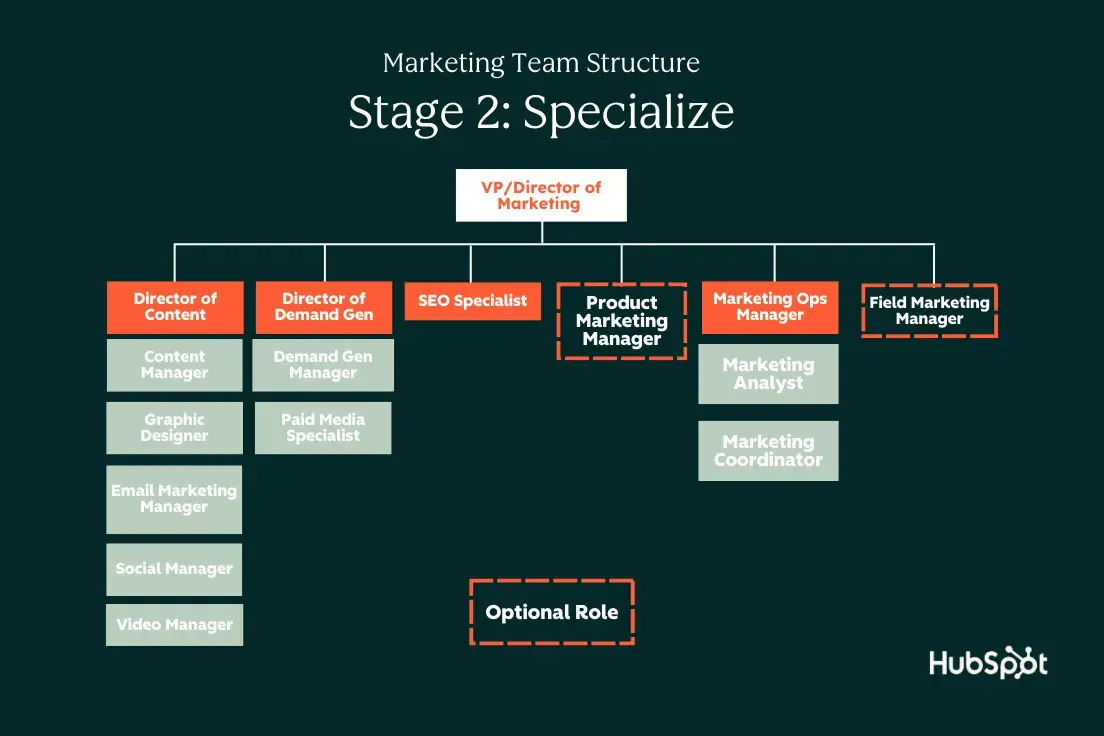
Once a company surpasses $15M ARR and serves over 500 customers, it enters a new market with larger competitors. This means marketing must become more sophisticated and often complex to attract attention.
With this in mind, phase two introduces specialization and a layer of management. Specialization usually takes place based on channel ownership to improve performance tracking, enable focus, and support repeatable growth.
Specialized Marketing Roles
Director of Demand Generation
This role oversees both paid and inbound efforts focused on driving conversions and sales. They’ll also likely manage the demand generation manager.
Efficiency Metrics: Leads generated, task completion rate, campaign support accuracy, and coordination turnaround time
SEO Specialist
Your content manager handled SEO in phase one, but as you grow, you need more advanced knowledge and skills to see improved visibility and site performance in search engines. That’s where this hire comes in.
Efficiency Metrics: Task completion rate, campaign support accuracy, coordination turnaround time, and organic traffic.
Email Marketing Manager
This is another responsibility that grows out of the content marketing manager’s responsibilities. It’s focused on lead nurturing and communications via lifecycle campaigns and retention.
Efficiency Metrics: Number of email campaigns launched, email open/conversion rate, campaign support accuracy, and coordination turnaround time
Resources:
Social Media Manager
Social media is a must these days, and as we’ve learned as an industry, it’s a full-time job. This role will manage your brand’s presence and engagement on various platforms.
Efficiency Metrics: Task completion rate, campaign support accuracy, and coordination turnaround time
Videographer or Video Marketing Manager
Video is a non-negotiable in today’s world, mainly thanks to social media. Phase 2 is a smart time to invest in talent that can help you build and scale this strategy.
Efficiency Metrics: Number of videos completed, campaign support accuracy, and coordination turnaround time
From here, additional content writers may also be needed to help scale content output, or a campaign manager coordinates cross-channel initiatives tied to revenue. It depends on your strategy, goals, and bandwidth.
Also, at this point, you are in a better position to explore a remote or hybrid structure. You may even start considering international team members. With your foundation built and solid, you likely have the processes, tools, and documentation needed to support team members in different locations while maintaining consistency.
Organizationally, the team should begin forming functional teams with clear leaders who act as middle managers. Channel-specific ownership improves focus (e.g., content, search, and demand), and the analytics function should stand alone for objectivity and rigor.
Expected Impact: Drive reliable, scalable performance across every channel and introduce efficient campaign processes.
Phase 3: Scale (18–25 People)
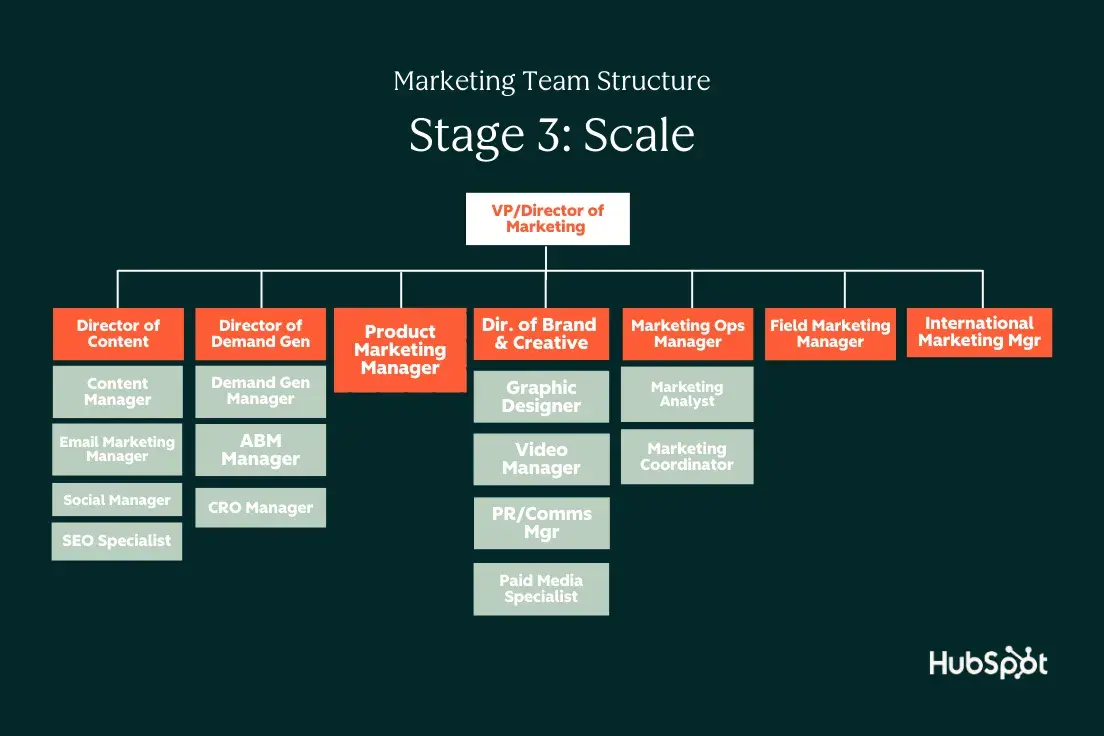
At the final stage — triggered when the company reaches $40–100M ARR and 1,000+ customers — structure your marketing team to support global operations and long-term scale.
That means introducing a fully layered marketing organization with both strategic and executional roles across functions and regions.
Marketing Roles for Scale
New role considerations include:
Director of Product Marketing
This role owns and guides the vision for the go-to-market strategy and enablement. They also manage the product team.
Efficiency Metrics: Task completion rate, campaign support accuracy, and coordination turnaround time
Director of Brand or Creative
This role leads brand storytelling and visual identity. They also likely manage any graphic designers.
Efficiency Metrics: Task completion rate, campaign support accuracy, and coordination turnaround time
Account-based Marketing (ABM) Manager
This role focuses on marketing to key segments or even specific accounts. It dances the line of sales and marketing and can enable sales and marketing alignment.
Efficiency Metrics: Task completion rate, campaign support accuracy, and coordination turnaround time
Resources:
- 8 steps to build your account-based marketing strategy [+ recommended tools]
- Free Account Planning Template
Conversion Rate Optimization (CRO) Manager
This role works on improving on-site and funnel conversion rates.
Efficiency Metrics: Conversion rate, Task completion rate
Marketing Automation Specialist
This role supports backend workflows and integrations. This could be related to operations, service, or even web and marketing.
Efficiency Metrics: Workflows launched, Task completion rate
Customer Marketing Manager
This role drives engagement and retention. They are focused on keeping customers happy and loyal.
Efficiency Metrics: Task completion rate, campaign support accuracy, and coordination turnaround time
PR/Communications Manager
As you become a global name, how the media and public perceive you in general becomes increasingly important. This role will oversee media relations and external messaging to help you create the best image.
Efficiency Metrics: Task completion rate, campaign support accuracy, and coordination turnaround time
International Marketing Lead
Speaking of going global, this role will focus on managing localization and regional expansion.
Efficiency Metrics: Task completion rate, campaign support accuracy, and coordination turnaround time
At this stage, the structure should include at least two layers of leadership, with Directors managing Managers and clearly defined functional areas like Brand, Demand Gen, Product Marketing, and Ops.
Expected Impact: An enterprise-ready team that drives both pipeline and brand awareness across markets. The team must also align on both global strategy and localized execution.
Now, let’s put all of this together.
How to Scale a Marketing Team
To build a scalable marketing team, you can’t just hire anyone for the sake of headcount. Scaling a marketing team requires structured hiring and team organization aligned with the current state of your business and what it wants to achieve (growth phase).
Follow these five steps:
1. Identify your growth phase.
Before hiring, identify which growth phase your company is in based on annual recurring revenue (ARR) and customer count. Each of the three phases (Foundation, Specialization, Scale) has distinct hiring priorities and structural needs.
Use these to evaluate your team, identify the roles you need, and set revenue milestones as hiring checkpoints to avoid premature specialization or understaffing.
2. Assess your current marketing abilities.
Map your existing team’s skills, bandwidth, and effectiveness. Look for any gaps between current output and what’s needed to hit next-phase goals. This will help you decide what areas you need to improve or introduce.
If you’re just getting started, you’ll likely have to start from scratch with your foundational marketing roles and generalists, but if you have those covered, it may be time to start looking into specialists.
3. List your hiring priorities.
Rank potential roles based on your current skill gaps, underperforming channels, and operational strain, along with your revenue goals. Prioritize roles that directly drive pipeline or remove friction. Those will deliver the most immediate results. (But we’ll talk more about prioritization shortly.)
4. Establish clear role definitions, metrics, and expectations.
Document responsibilities, success metrics, and reporting order for each role. Unclear roles can create overlap, confusion, and conflict that just work against your goals.
If you’re just getting started with marketing, your founding hires will likely develop the workflows for content production, campaign execution, lead handoff, and performance reporting that work for them. But if you’re scaling and adding specialists, it’s wise to establish some processes and guidelines. New team members onboard faster and maintain consistency when processes exist. Without guidance, growth creates chaos.
5. Create Regular Structure Review Cadence
Stripe says ambitious teams typically restructure every 6–9 months to stay aligned with business growth. With that in mind, schedule reviews at least quarterly to assess whether structure still serves goals.
Be ready to adjust reporting lines, combine functions, or split teams as complexity increases.
How to Prioritize Roles When Scaling a Marketing Team
In the perfect world, you’d love to hire all these folks, right? Unfortunately, the business world is not that rosy (especially right now).
Use these five points to help you decide what marketing roles to prioritize:
- Evaluate the revenue impact potential of the role and whether it ties directly to growth targets.
- Identify skill gaps within your existing team and hire to complement existing capabilities.
- Assess underperforming channels that require new expertise or leadership.
- Consider where the team is stretched operationally and needs support.
- Align with long-term strategic initiatives such as expansion, branding, or product shifts.
In-house vs Outsourcing
Depending on your goals and strategy, not every role will need to be a full-time employee (FTE), especially early on. Understanding when to build in-house versus outsourcing can optimize both budget and execution speed.
Insource (hire full-time) your marketing talent when the work:
- Depends on company expertise: Roles like demand generation, product marketing, and content strategy require deep product knowledge and should be in-house
- Heavily drives pipeline or revenue: If a channel drives >30% of pipeline, bring that expertise in-house for better control and optimization
- Is critical to the brand: Messaging, positioning, and brand voice need internal ownership to maintain consistency
- Involves data and operations: Marketing ops, analytics, and automation require system access and integration knowledge
Pro Tip: As 3Search’s 2024 Annual Pay & Hiring Report found, 12% of employees rank ‘career development opportunities’ as their first priority in a job search, so building a team structure that offers in-house growth will help with retention as well.
Outsource (use contractors/agencies) your marketing talent when the work:
- Is a supporting task: Graphic design, video editing, and basic content production scale better with freelancers.
- Depends on specialized expertise: SEO audits, paid media strategy, or conversion optimization may require occasional expert input rather than full-time roles
- Is temporary or project-based: Campaign surges, event support, or seasonal peaks can be handled with contractors
- Involves new channels: Before hiring a full-time TikTok manager, test the channel with an agency or freelancer
In-house vs. outsourcing advice can also vary depending on your company’s phase. Many early-stage companies use fractional CMOs, freelance writers, or design agencies until they can prove viability or secure budget.
Here’s an example of what in-house vs outsourcing could look like by phase:
- Phase 1: Fractional CMO + 2-3 FTEs + freelance designers and writers
- Phase 2: Full marketing leadership + core FTEs + specialized agency support (video, localization)
- Phase 3: Complete in-house team + agencies for market expansion and overflow work
Best Tools for Scaling Marketing Teams
Even if you have the talent, it’s wasted without the right tools to execute. Let’s take a look at what your tech stack could look like in our three phases of growth.
Foundation (5-10 people)
At this stage, focus on core functionality that covers multiple needs rather than specialized point solutions.
Essential tools:
- CRM: HubSpot CRM (free tier available) provides contact management, deal tracking, and basic reporting
- Email Marketing: HubSpot Marketing Hub Starter or Mailchimp for email marketing, landing pages, and basic workflows
- Content Management/Publishing: HubSpot CMS or WordPress for website and blog management
- Design: Canva for quick graphics and basic design work
- Analytics: Google Analytics 4 for website tracking and performance measurement
Budget consideration: Aim to keep total martech spend under $2,000/month in Phase 1. Free tiers and bundled solutions like HubSpot can help keep costs low and tools unified.
Daniel Foulkes Leon, Senior Marketing Operations Manager at CoachHub, a HR tech company based in Germany, explains how HubSpot helped his team scale and secure $330 million in financing.
“In twelve months, [our team had] grown from 250 to around 1,000 employees,” says Daniel. “We needed to find some quite elaborate ways to prioritize the work and automation….HubSpot gives us tools that we don’t use in separate universes, but rather together. And everyone benefits from that.”
Overall, HubSpot’s unified platform supports scalable marketing team structures at every growth phase
Specialization (11-17 people)
As the company matures, you refine your channels, and specialists join, invest in tools that deepen capabilities and improve attribution.
Core stack upgrades:
- Marketing Automation: Focus on automating lead scoring, email nurture sequences, social publishing, and performance reporting. These repetitive tasks consume disproportionate time as teams grow. Upgrade to tools like HubSpot Marketing Hub Professional or ActiveCampaign for advanced segmentation, attribution, and workflow automation
- SEO: Ahrefs or Semrush for keyword research, competitive analysis, and rank tracking
- Social Media Management: Hootsuite or Sprout Social for scheduling, monitoring, and analytics across platforms
- Email: Upgrade email capabilities with tools like Iterable or Customer.io for advanced personalization
- Analytics: Add Google Tag Manager, Mixpanel, or Amplitude for event tracking and behavioral analysis
- Project Management: Asana, Monday.com, or ClickUp for campaign coordination and workflow management
At this phase, integration matters more than individual tool features. Look for native connections or use Zapier to connect your stack. Marketing teams waste hours on manual data transfer without proper integrations.
You’ll also likely need to start introducing collaborative platforms (i.e. Google Docs, Asana) and communication tools like Slack to prevent silos.
Scale (18-25)
Global scale requires enterprise platforms with advanced personalization, ABM capabilities, and multi-market support. Enterprise marketing stacks typically cost $50,000-$200,000+ annually, but the ROI justifies the investment when managing complex, multi-channel campaigns across global markets.
Enterprise stack:
- Advanced Marketing Automation: HubSpot Marketing Hub Enterprise, Marketo Engage, or Pardot for sophisticated attribution, revenue reporting, and ABM
- ABM Platform: 6sense, Demandbase, or Terminus for account-based marketing and intent data
- Advanced Analytics & Attribution: Bizible, HockeyStack, or Dreamdata for multi-touch attribution across the entire customer journey
- Customer Data Platform (CDP): Segment or mParticle to unify customer data across systems
- Conversation Intelligence: Gong or Chorus for sales-marketing alignment and message optimization
- Digital Experience: Optimizely or VWO for A/B testing and personalization at scale
- Artificial Intelligence: According to research from Optimizely, marketing teams using AI tools have seen productivity uplifts of over 40% when implemented with proper governance and training. At this phase, AI-powered tools can help scale content generation, offer predictive analytics, facilitate data management, and automate optimization.
Pro Tip: Believe it or not, the scale phase often means reducing tool count. Platforms like HubSpot’s Enterprise tier or Adobe Experience Cloud, for example, replace multiple point solutions, reducing integration complexity and improving data quality.
Regardless of phase, follow these principles:
Tool Selection Best Practices
- Start with one platform that covers multiple needs rather than buying separate best-of-breed tools
- Prioritize native integrations over workarounds: Broken integrations cause more problems than missing features
- Evaluate based on your team’s skill level. Powerful tools with steep learning curves waste money if your team can’t use them
- Plan for the next phase. Choose tools that can grow with you to avoid expensive and complicated migrations.
- Track tool utilization. If a tool isn’t used by at least 60% of intended users, replace it.
FAQs about scaling a marketing team
What’s the ideal leader-to-individual contributor ratio?
Start with a ratio of 1 leader to 5 or 6 individual contributors (as outlined in phase one). As complexity increases, Directors or middle managers should manage smaller groups of three to seven. Don’t overload a manager. Keep these guidelines in mind:
- Managers should typically oversee 4 to 7 direct reports.
- Directors should manage 3 to 5 team members or leads.
- The VP of Marketing should supervise 4-6 direct reports to ensure strategic alignment.
How do I prevent silos?
You can prevent silos by introducing a management layer before teams grow too large. Cross-functional meetings and shared metrics tied to revenue rather than to function also help maintain alignment. Collaborative tools and platforms such as Slack, Google Docs, and Asana help improve communication and data sharing.
When do I hire marketing specialists?
Avoid hiring too many specialists before you know what channels and mediums work for your audience.
Specialist roles should be introduced in phase two when your team size is 11–17 people, and ARR is about $15–20M. This is typically when your business needs dedicated focus per channel and deeper brand expertise. It’s also when you’ll likely have the processes, tools, and resources in place to start refining.
Should I hire full-time employees or contractors?
You can use contractors for executional or temporary needs, such as design or video. However, you should prioritize full-time hires for strategic or core functions like demand generation or product marketing. Don’t prioritize creative hires without a strong strategic plan in place.
Build to Scale, Not Just to Survive
The reality is: your marketing org is either your growth engine or your biggest bottleneck. Structure it to scale, because when you’re growing, guesswork costs too much.
Ready to future-proof your team? Use this framework, revisit it often, invest in tools like HubSpot to execute, and adjust as your strategy evolves. Growth waits for no one — but with the right plan, your marketing team won’t just keep up. It’ll lead the charge.
Editor’s note: This post was originally published in August 2025 and has been updated for comprehensiveness.

from Marketing https://ift.tt/ujd95pH
via IFTTT